
?unique=82997e6)
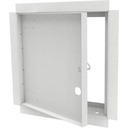
Babcock-Davis BRW-C Recessed Access Door | Seamless Mud-In Drywall Finish
The Babcock-Davis BRW-C is a high-end architectural solution designed for projects that demand a perfectly flush, "invisible" utility access point. Unlike standard doors, the BRW-C features a drywall bead flange (mud-in) and a recessed door pan. This allows you to insert a 5/8" piece of drywall directly into the door leaf and tape/mud the frame into the wall assembly. Once finished and painted, only a narrow 1/16" gap remains visible, ensuring the panel blends seamlessly with the surrounding texture.
Constructed from 16-gauge steel, the Babcock-Davis BRW-C provides rugged durability while maintaining a minimalist aesthetic. It comes equipped with a concealed pin hinge and a screwdriver-operated cam latch, keeping your mechanical and electrical systems secure but easily accessible for maintenance
Key Features & Specifications
- Total Concealment: The combination of a drywall bead flange and a recessed pan allows the door to match the wall's exact color and texture.
- Drywall Integration: Engineered to house a 5/8" drywall insert or acoustic tile within the door for a fully integrated look.
- Architectural Quality: Built with a 16-gauge steel frame and a 20-gauge steel door to prevent warping or sagging over time.
- Clean Profile: Features a concealed pin hinge that allows the door to sit perfectly flush without protruding hardware.
- Tool-Assisted Access: Includes a reliable screwdriver cam latch for a secure, tamper-resistant closure.
- Corrosion Protection: Finished in a White Powder Coat that acts as a high-quality primer for final field painting.
Technical Specifications
- Material: 16-Gauge Steel Frame / 20-Gauge Steel Door
- Flange Type: Drywall Bead (Mud-in)
- Hinge: Concealed Pin
- Latch: Screwdriver Cam Latch
- Finish: White Powder Coat
- Recess Depth: 5/8"
Pro-Tips for a Seamless Access Panel Finish
- Prep the Frame: Ensure the panel is installed level and flush with the drywall surface. Before mudding, use a damp cloth to remove any dust or oils from the perforated flange to ensure maximum compound adhesion.
- Protect the Hardware: Apply painter’s tape over the latch (screwdriver cam or knurled knob) and the thin gap between the door and the frame. This prevents joint compound from clogging the mechanics or "gluing" the door shut.
- Use Setting-Type Compound: For the first coat (the "tape" coat), use a setting-type joint compound (often called "hot mud"). It shrinks less than all-purpose air-dry mud and provides a stronger bond to the steel flange.
- Feather Widely: To make the 1/16" frame edge disappear, feather your mud out at least 6 to 10 inches away from the flange. Use a wide joint knife (10" or 12") for the final skim coat to create a gradual, imperceptible transition.
- Sand with Care: Once completely dry, lightly sand the area with fine-grit sandpaper (220 grit). Be careful not to sand through to the metal flange, as this can cause "ghosting" where the metal shows through the paint later.
- Prime and Paint: Access panels come with a white powder coat, which is a great base, but always apply a dedicated drywall primer over the mudded area and the door itself before your final topcoat to ensure uniform color and texture.
| Visual Size | 8" x 8" or 12" x 12" or 16" x 16" or 18" x 18" or 22" x 30" or 24" x 24" or 24" x 36" |
| Brand | Babcock-Davis |
| Fire Rated | Non-Rated |
| Flange Type | Drywall Bead |
Recently Viewed Items