
What Is a Mortise Cylinder Cam -- and Why Does It Matter?
If you have ever ordered a mortise cylinder replacement and ended up with a lock that turns freely but does nothing, there is a good chance the cam was wrong. A mortise cylinder cam is the small rotating lug at the base of the cylinder that physically actuates the lock mechanism when a key is turned. It is a simple part, but it is highly specific. The wrong cam profile means the cylinder physically cannot engage the tailpiece geometry of the mortise lock body it is installed in -- and the door will not function correctly no matter how well everything else was specified.
Why Every Manufacturer References Mortise Cams Differently
Here is where the frustration starts for contractors and facility managers: there is no universal cam naming standard across the hardware industry. Every cylinder manufacturer has developed its own part numbering system, cam profile names, and ordering logic. A cam that Hager calls a "Sargent/Yale Cam" (part 3977 in conventional mortise format) corresponds to what PDQ labels a "Sargent Std Cam" (part I127-4204 in conventional format) and what Sargent itself simply calls the "Standard Cam" (part 13-0664). Three names, three part numbers -- same basic function. Multiply that across eight or more cam profiles and three cylinder housing formats (conventional mortise, SFIC, and LFIC), and the potential for ordering errors grows fast.
How Sargent Organizes Its Mortise Cylinder Cams
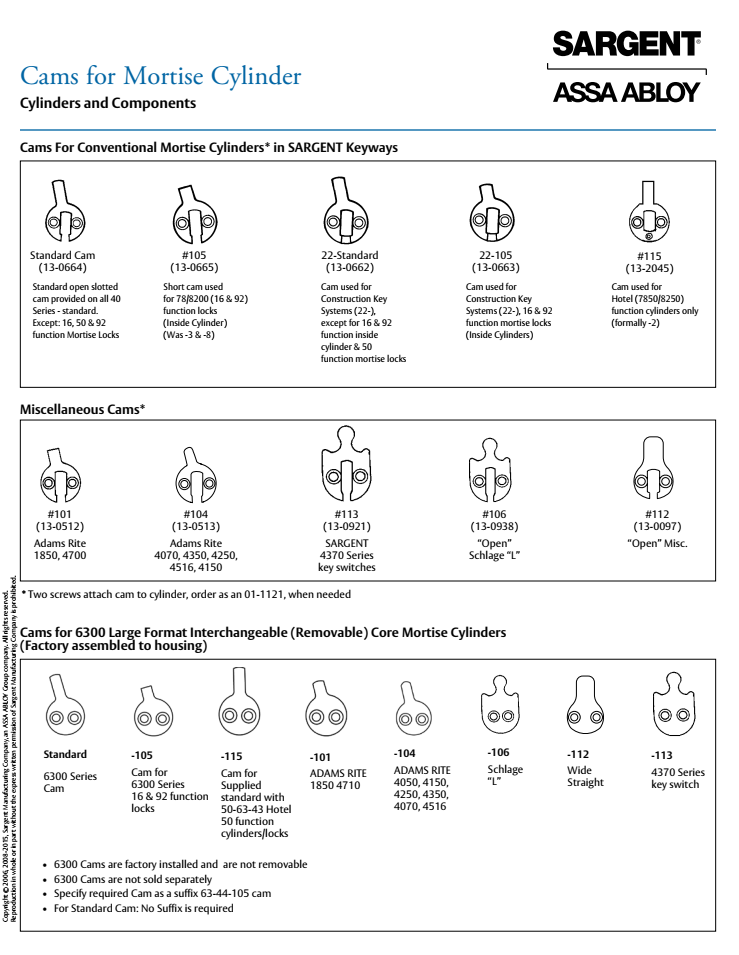
Sargent structures its conventional mortise cylinder cams around lock function numbers. The Standard Cam (13-0664) ships as the default on all 40-series locks, covering the majority of applications. The #105 cam (13-0665) is a short cam used specifically for 7650/200 series locks in 16 and 92 functions -- inside cylinder only. Construction Key System applications require the 22-Standard (13-0662) or 22-105 (13-0663) variants depending on the function involved. Hotel applications running the 92 function use the #115 cam (13-2045). For Adams Rite integration, Sargent offers dedicated cams by series -- #101 (13-0512) for the 1850 and 4700 bodies, #104 (13-0513) for the 4070, 4350, 4250, 4516, and 4150. On the 6300 Series LFIC side, cams are factory-assembled to the housing and cannot be field-swapped -- the correct cam suffix must be specified at the time of order (for example, 63-44-105 for a 6300 with the #105 cam). If no suffix is listed, the standard cam ships by default.
How PDQ Organizes Its Mortise Cylinder Cams
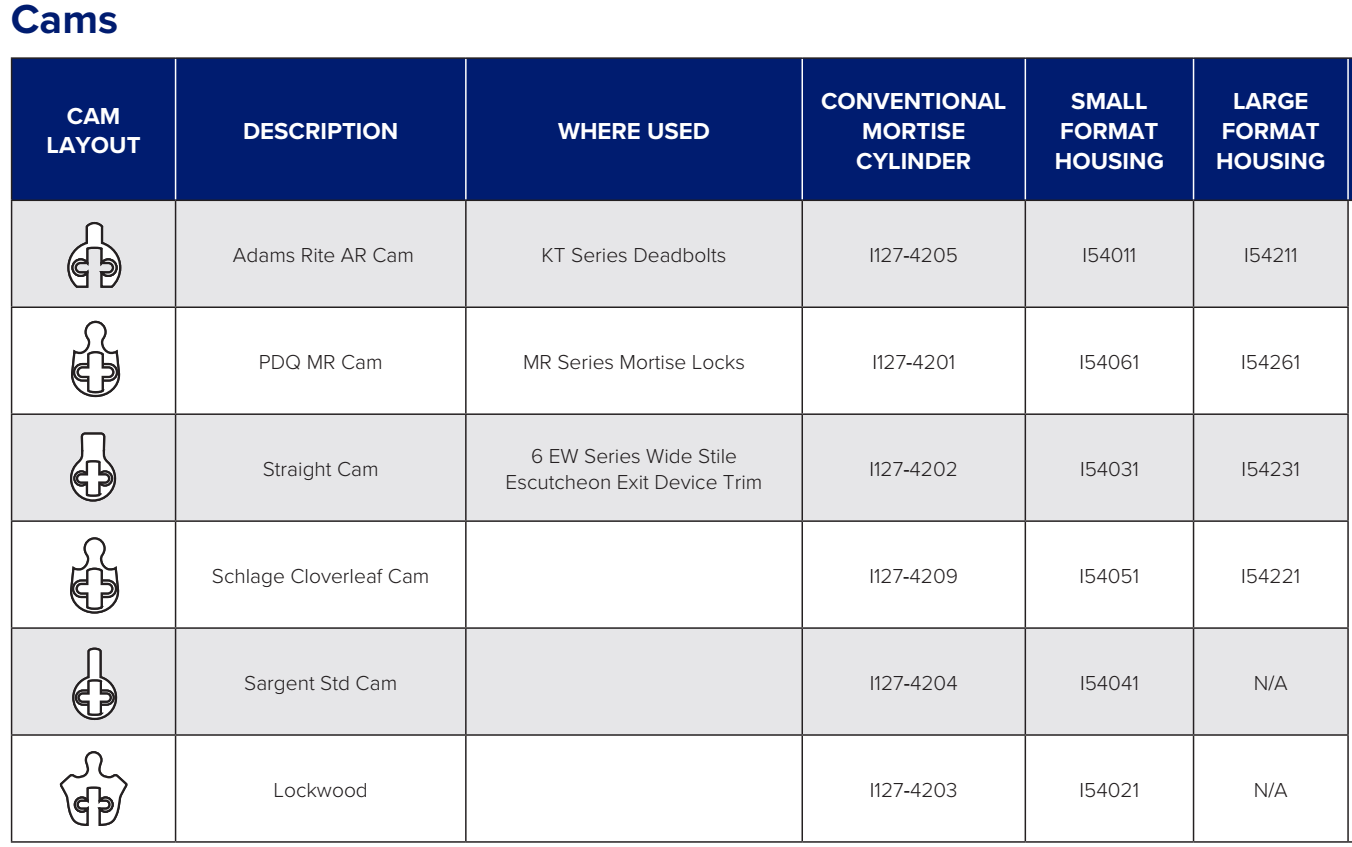
PDQ takes a matrix approach, offering six named cam profiles that each carry a distinct part number depending on which of the three housing formats you are ordering: conventional mortise (prefix I127-4xxx), SFIC (prefix I540xx), or LFIC (prefix I542xx). The PDQ MR Cam (I127-4201 conventional) is purpose-built for PDQ MR Series mortise locks. The Adams Rite AR Cam (I127-4205 conventional) covers KT Series deadbolts. The Straight Cam (I127-4202 conventional) is used with 6 EW Series wide stile escutcheon exit device trim. Two important limitations to know: the Sargent Std Cam (I127-4204) and the Lockwood cam (I127-4203) are only available in conventional mortise and SFIC formats -- there is no LFIC version of either. Every other cam in the PDQ lineup is available across all three housing types.
How Hager Organizes Its 3902 Series Mortise Cylinder Cams
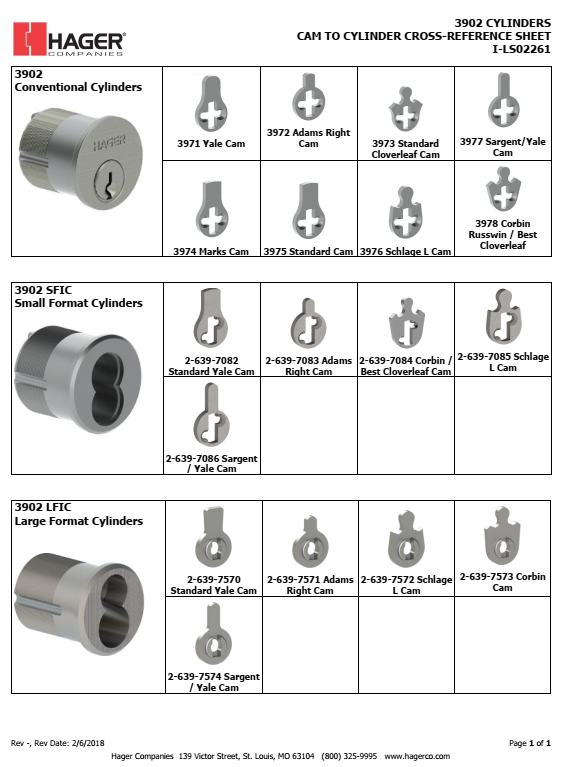
Hager uses simple sequential part numbers within the 3902 cylinder series. Conventional mortise cams run from part 3971 through 3978, covering Yale, Adams Rite, Standard Cloverleaf, Marks, Standard, Schlage L, Sargent/Yale, and Corbin Russwin/Best Cloverleaf profiles. The SFIC format (prefix 2-639-708x) offers five cams, consolidating some profiles. The LFIC format (prefix 2-639-757x) offers five cams as well but with a leaner profile set -- notably, the Marks Cam (3974) is conventional-only with no SFIC or LFIC equivalent, and the Corbin Russwin/Best Cloverleaf combination simplifies to a generic Corbin Cam in LFIC format (2-639-7573). The Sargent/Yale Cam is one of the few profiles that carries through all three housing formats in the Hager 3902 line, making it one of the most consistently available options across the catalog.
The Bottom Line: Match Cam to Lock Body, Housing, and Function First
Before you order any mortise cylinder, confirm three things: the lock body brand and series the cylinder must actuate, the cylinder housing format (conventional, SFIC, or LFIC), and the lock function. Armed with those three data points, you can cross-reference the correct cam from whichever cylinder line you are specifying -- whether that is Sargent, PDQ, Hager, or another preferred line in our catalog. DoorwaysPlus stocks mortise cylinders and cam components across all major formats and can help you cross-reference the right configuration for your project. Contact our team or browse our mortise cylinder section to get the correct part the first time.